Should You Have A “Cheat Day”?

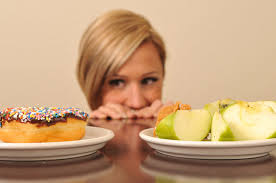
donut vs apple and womanWhen I hear a person say “Saturday is my cheat day” I gotta be honest, it pushes my buttons. To most people it sounds like a harmless thing, but to me it is a red flag. An alarm goes off, triggering this irritating feeling throughout my body. I try not to react, it is a conscious decision on my part to ignore it if I am overhearing a conversation in the elevator of the hospital where I work part time, or somewhere else where there really is not time to get into it. Otherwise, such as a party or other informal gathering where women especially tend to chat about what they are doing to change their bodies…. I always take the opportunity to educate people about Health at Every Size, and how focusing on being healthy verses being thin is a much more sane goal. Then I may ask what they mean by”cheat day”. Inevitably, it means following some type of “healthy” eating plan or dieting throughout the week, then allowing themselves to overeat any of the foods  they have denied themselves during the week on Friday or Saturday, and often again on Sunday.

What bothers me about this approach to eating is that it ignores all of the principles of “mindful” eating, and about “listening to your body” . It gives food so much more power than it deserves. It makes me think of how back in the day (and actually still today unfortunately) food is used as a reward. For example, “if you finish your spinach, you can have the cookie”. What does that message send? It says “something is very wrong with spinach, and something is very special about cookies”. I wish food was never treated this way. If you are really honest with yourself, you have to admit, that sometimes fresh vegetables or a great salad or roasted garlic with asparagus is extremely yummy. And an Oreo cookie could never substitute for that taste. If however, one were to hold that Oreo up as a reward, then it might be different. Over time,we might become conditioned to look at that sweet in a different way, and want it even if we really didn’t want it! If we really were mindful and not conditioned to think some foods were good and some foods were bad (that we could only eat them on a “cheat” day) and REALLY listened to what our bodies wanted, then we would not even need a “cheat” day. We would eat in a mindful way, cooking meals that were healthy and that we enjoyed, because we want to feel good, have energy and live a long and healthy life. But that means enjoying the fun foods too, the ones that are important to us, in our culture, our family traditions or socially. Having a homemade blueberry muffin at Grandma’s house or sharing a favorite dessert when out with our old college roommate,or Grandma Harmon’s favorite cinnamon buns that you only get once in a blue moon. It may not be a Saturday or a “cheat” day, but it may be and should be just part of normal life. Monday, Tuesday, Wednesday, Thursday, Friday, Saturday, Sunday….I hope everyday you listen to your hunger, and fullness, and enjoy healthy eating, have energy, and never miss an opportunity to enjoy a serving of a special food that you enjoy. Heck with “cheat” days. Enjoying life is living, not cheating.

Are You in Diet Jail?

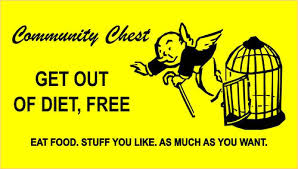
Idiet jail first encountered the term “Diet Jail” in 1975. I was a biology major at Clark University in Worcester, Mass. I remember clearly working with the lab teacher who was doing his research on birds (he kind of looked like a cool woodpecker). He made me count bird chirps he had taped on a recorder. I decided I did not want to be a biology major because counting bird chirps was incredibly boring. So I met with my adviser who asked me what I was interested in. My best friend Joyce was a vegetarian and ate very interesting things such as yogurt with sunflower seeds and honey, and so I told him, I though vegetarianism was interesting. He told me I should be a dietitian. I did not know what that was, but anyway, I ended up transferring to the University of Connecticut to study nutrition. For my first nutrition class (Nutrition 101) I had to do a  report about fad diets and at the time there were many books out there on the market, including the Atkins Diet. But I found one called “The Psychologist’s Eat Anything Diet” by two psychologists, Dr. Pearson and his wife, also Dr. Pearson.  It changed my thinking in a way that lasted, well, forever. The authors were decades before their times in the strategies they were promoting, before we knew about mindful eating or how our bodies regulated themselves regarding calorie intake, fat, carbohydrate intake, etc. They described what they called “diet jail” where individuals who diet tend to “lock themselves up” in a jail where only the healthy foods exist. In other words, they tell themselves they are only going to eat healthy foods such as grilled chicken, vegetables, fruits, salad, etc until they lose the weight. So psychologically it is as if they “lock themselves up” in a world where only the healthy foods are available (or allowable). But outside the jail are all the other foods, the “bad” foods. The chips, cookies, ice cream, burgers, pizza, you get the picture. All the foods they have determined they are not allowed to eat (while they are on that diet). And so, most people can last a bit in Diet Jail. Yes, they get cravings, but they use their “willpower” and overcome them. Unfortunately, we now know our bodies send out very loud signals when we are not getting enough carbohydrate or fat (the foods that do not exist in Diet Jail!) and so eventually, our bodies drive our brains to give in. Add this physiological drive to an environmental trigger, such as walking into your friend’s home who just baked some homemade chocolate chip cookies, and things change. Your brain, which is triggered by the deficiency in your body, tells you to eat a cookie! It has just what you need, what you have been missing, that fat and carbohydrate! But you can’t have someone throw just one cookie into your jail cell, so you have to step out of the jail to get that one cookie…….the problem is, once you take that bite, your realize you are out there! Out of Diet Jail! And since you know you will go back in (you tell yourself that on Monday you will really start again!) you better eat while you are out here! So you decide to order pizza, and then have ice cream (a lot) because, heck, you are going to start again on Monday. Often a full blown binge results. Because you know this is just this one time. Soon you will be back on track. Back in Diet Jail. Until the next time.

As repetitive as this cycle is in so many people’s lives, they do not seem to stop. The next diet craze offers the next magic scheme. Weight is lost and then regained. Back then we did not know the physiological reasons people were driven to eat but now we do. We know if you restrict you will suffer from “disinhibition” or breaking out of Diet Jail.Often referred to as the “what the hell” effect. It is a very sad and draining cycle.

So why not take those bars down? Why not entertain the thought of changing what you have been doing that is not working? What if you were to start to believe that all foods are equal? No food is good, no food is bad, they all have a place in your life. Yes, we need certain nutrients to feel good, have energy, normal bowel movements, prevent disease, etc. So educate yourself (I will gladly help you!), experiment, enjoy your cultural traditions (yay. pasta fagioli!) but start paying attention to your body. Are you hungry? Are you full? Are you so confused that you might really want to get some help (such as from an eating disorder specialist?). Wherever you are, it is ok, just take some time to truly reflect on your patterns. My hope for you is to enjoy eating, be healthy, and take down those darn bars.

What is “HAES”?

images

I have a few simple questions to ask before I explain what HAES is:

1. How many people have you known who have “gone on a diet” specifically to lose weight?

2. Have you ever known someone who has gone on a diet and who has lost weight and kept it off? I am not talking about the person who took up a sport or quit smoking and adopted a healthier life style. I am talking about someone who followed a specific “diet plan” such as a low carb diet or meal replacement diet or counting calories or points kind of diet.

3. Have scientists discovered the one diet that works to help people lose weight and keep it off? Of course we know researchers have been looking into this, since people have been struggling with trying to lose weight for a long time. The “obesity epidemic”is always in the news. So have they found the one diet that works?

Not sure of your answer for question #1, but for #2, I am guessing the answer is NO, and for question #3, I will tell you the answer is NO. What most of the public does not know (because who would be interested in the research over the years regarding dieting except someone like a dietitian?) is that many researchers have been looking into dieting behavior for decades. In fact, when I went back to graduate school and did my research on “cognitive restraint” back in the ’90’s, I was angry! I could not believe the world did not know that the “experts” already knew many of the reasons dieting did not work! But then I realized, it is about the diet industry combined with desperate people wanting to lose weight.

I was not the only one who was angry. There now exists a split among health professionals working with people with weight issues (actually, the split has been there for many years but only recently gaining attention). Thanks to the more recent research and new groundbreaking books (see below) by Dr. Linda Bacon, the “Health at Every Size” Movement  has now been brought into the public eye and the movement is gaining momentum.. Those of us who believe in promoting health instead of some perfect weight, are no longer alone. Yes, there are still doctors, nurses and dietitians who will put someone on a diet (boy could I tell you some horror stories). So it is important to ask any professional you are working with which side of the fence they are on. Are they familiar with the HAES Approach? If not, they may be a bit behind the times. Or, they may still be influenced by a society who values a certain physical appearance instead of health.

Here is an excerpt taken the HAES website at http://www.haescommunity.org/  :

“Health at Every Size” is based on the simple premise that the best way to improve health is to honor your body. It supports people in adopting health habits for the sake of health and well-being (rather than weight control). Health at Every Size encourages:

  • Accepting and respecting the natural diversity of body sizes and shapes.
  • Eating in a flexible manner that values pleasure and honors internal cues of hunger, satiety, and appetite.
  • Finding the joy in moving one’s body and becoming more physically vital.

  • and from Dr. Linda Bacon: “Health at Every Size is the new peace movement.”

    “Very simply, it acknowledges that good health can best be realized independent from considerations of size. It supports people of all sizes in addressing health directly by adopting healthy behaviors.”

    If you are tired of dieting and ready to focus on health instead of some magic number on the scale, check out  Health at Every Size: The Surprising Truth About Your Weight by Linda Bacon, PhD and her most recently released book, Body Respect (http://thebodypolitic.biz/bodyrespect/), co-authored with Lucy Aphramor

  • And be sure to check out the HAES website at http://www.haescommunity.org/

Vegetarian Diets….the question is “why”?

veggie burger

Why on earth would a dietitian even question a vegetarian diet when it seems like such a healthy way to eat? Eliminating all that saturated fat in the form of meat from your diet has to be a good thing, right? And when you think of vegetarians, don’t you get a vision of someone munching on a giant salad?

Well, let me give you a reality check. Having been around the block a few times (meaning I have been a dietitian for over 35 years),  I have encountered my share of vegetarians. When someone tells me they are a vegetarian, or a vegan, I do not make any assumptions about their diet or their intentions. But what I have found is that the reasons people become vegetarian are not always clear. I have noticed that people turn to a vegetarian diet for a few different reasons. In fact, I have encountered 3 types of vegetarians over my long career as a nutritionist (my experience only, I can’t speak for everyone). The people I have worked with or have known in my life tend to fall into the following categories:

1. The True Vegetarian: This is the individual who truly has a strong empathy for animals. They just are not comfortable with consuming them.  They may have had meat in their lives but then, they change and make a decision that they do not want to eat meat any longer. There are different types of vegetarians, those who are ok with eating dairy or eggs or fish, but not meat. I remember my daughter as a teenager getting very upset when the rodeo was in town, and she actually joined a group who stood on the corner and protested. This led her to looking into protecting animals and she decided to stop eating meat at the time. I also have a best friend who is vegetarian, is a great cook, and who also is all about protecting animals (it is a passion with many vegetarians I have come to know over the years). They eat everything, just not meat. I have to say, not all of those I have met who are true vegetarians are healthy eaters like my friend. Many people (especially teenagers who love their kid-foods) tend to live on noodles and chips, still vegetarian, but no vegetables involved!

2. The “I want to be healthier” Vegetarians“: These are the people I have encountered who may have developed some health issues such as high cholesterol, and decided they are going to “cut down on” meat consumption. The reason they want to change their diet is because being healthy is important to them. They may have an occasional meal with meat, but otherwise they believe eating less of it is healthy.

3. The “I am pretending to be vegetarian because it is a good excuse to eat less” Vegetarians: Unfortunately, I have worked with many people over the years with eating disorders who start out with “vegetarianism”. They start eliminating foods, and becoming a vegetarian is kind of a good “excuse” for the eating disorder to NOT EAT. This type of “vegetarian” is different in that they typically refuse to eat the normal vegetarian standbys such as peanut butter, nuts, beans, etc. They may say they do not like salad dressing, olive oil, trail mix, granola or nut butters. This is always a “red flag” to me. Most of the “True Vegetarians” I know rely on nuts and peanut butter for protein and have no problem with pasta and rice and beans and all the other food needed to round out their diets. Not to mention delicious Tofutti Ice Cream!

So what is the bottom line? If you or someone you knows decides to become vegetarian, always ask “why?” If it is to be healthier, or because you care about animals, then you can definitely meet your nutritional needs with some guidance. Vegan diets are a bit harder in that you may need supplemental iron, vitamin B-12 and calcium, and also you need to know how to get protein in your diet (I recommend seeing a Registered Dietitian to be sure-check out http://www.eatright.org and “Find a Dietitian”). But if you know someone who just started being a vegetarian, is losing weight, who no longer eats potato chips (those are vegan!) then don’t ignore it. It could be an eating disorder just beginning.

For more information from the Academy of Nutrition and Dietetics, check out: http://vegetariannutrition.net/

Healthy or Thin?

IMG_2637My guess is these two words get different reactions from different people. It has been my experience over the years that in our culture we assume pretty much everyone wants to be “thin”. And most people equate being “healthy” with being “thin”. Most of us assume if we tell someone they look “healthy” it would be a compliment. Or, we assume telling someone they are lucky they are so “thin” is also a compliment.

What I have learned from my patients is for those with eating disorders, being told you are “healthy” is equivalent to being told you are “fat”. For some of the patients I work with who have trouble gaining weight, being told they are “too thin” is very hurtful, as their body image concerns are often interfering with their lives just as the person who is concerned about being “too fat”.

My goal is to help people see that a goal of “healthy” is the smartest goal. The first step for some is working on their “self-talk” around the word “healthy” and eventually accepting it has nothing to do with your size. For others whose goal is being “thin”, instead changing to a goal of being “healthy” because that may be a goal they can actually achieve (not to mention, a goal of being healthy is also mentally healthier!)

I will always remember a teenage patient of mine who had moved from Africa and had lost a few pounds (still a very normal and healthy weight). Dad brought her in because he was very concerned about this. When I asked about his concerns, he said “I want her to be fat. Doesn’t everybody want to be fat?” He was very serious but I couldn’t help but smile inside. I did have to explain to him that we can’t always control that but I wanted to be sure she was “healthy”. He never came back ; )