
 I literally stopped in my tracks the other morning as I was walking out of the kitchen to go get dressed for work. The first thing I do when I get up in the morning (after pouring that critical first cup of coffee) is turn on the small television that is in our kitchen so that I can listen for the weather and traffic. Like most people, I have my routine that gets me out of the door on time. But that morning, the words I heard caught my ear and I had to listen. “New AMA Study shows calorie restriction has positive benefits!” Oh brother, here we go, giving people another reason to diet. I listened to the brief details (how much can you pack into a 2 minute blurb?) and learned that apparently decreasing your calorie intake by 25 percent can improve your mood, quality of life, sleep and sexual function. Really? I didn’t have time to check into it but knew I had to as I like to be prepared when someone asks me a question about things like this. Most people just automatically believe what they hear and that is what troubles me.
So I searched and found a summary of the study, see AMA Study To read the entire study you have to pay for the article unless you are a member of the American Medical Association (which I am not) so instead I just read the abstract. What I learned from working with many researchers in graduate school is that we need to consider many factors when it comes to study conclusions. We need to be critical. This is not easy, especially if the research is in an area where we are not experts. The field of nutrition and health is a complicated one because so many factors influence our health (and our weight). So I always look at a study and try to decide how much it means, if anything in the real world. I like to look at some of the obvious things, such as the number of subjects and the kind of people who were involved in the study as well as the length of the study. In this study, the 220 subjects were “nonobese” and “healthy”. The subjects were divided into 2 groups: “calorie restriction” (CR) or “ad libitum” (AL). The measures were taken over 2 years (initial, one year and 2 year) and the results are based on “self-report”, in other words, people answered questionnaires. We know there is always a degree of error in self-report measures as people often answer the way they think they are supposed to. We also can’t know all of the confounding factors, such as the other influences in peoples lives that might have had an effect (a new job, a new baby, getting married, etc.). There are so many factors that affect mood and energy level. To believe that simply decreasing calorie intake can have all these benefits is wishful thinking. Even if after many replicated studies (which is always needed to really show cause and effect) do you really think it would be easy to figure out how to decrease calories by 25 percent? That is a lot! How is nutritional status affected? What if someone decides to cut out milk to achieve this goal? What happens to their bone health over 10 years? Do you think you will be in a better mood if you have osteoporosis? When you can’t get up and walk without pain? Maybe I am being a bit sarcastic and extreme, but the point is, it is never ever that simple.
Unfortunately, the people who heard this news blurb and may react to it are probably the ones who are already dieting and restricting to lose weight. In particular, I worry about those with eating disorders who are looking for an excuse to restrict. Remember, there is always opposing research that shows the exact opposite. In this case, you probably don’t have to do a literature search to know (but there is plenty of evidence there) that starving yourself or excessive dieting is more likely to lead to depression, not being happy. It is more likely to decrease your quality of life, especially if dieting and weight obsession become your focus. People I have worked with who have struggled with eating disorders have often lost so much. Having to take time away from college, or your family to be admitted to the hospital due to dehydration or starving, not being able to participate in activities you always enjoyed just because you don’t eat enough, even not being able to drive (I have seen it). Losing friends because they just can’t be around you any longer and watch you do this to yourself. ….this is the reality of calorie restriction.
Instead, when you hear a news blurb that briefly shares a dramatic result such as this one, stop and think about how different we all are. Our lifestyles are unique, our dieting history and relationship to food is unique, and most importantly, our genetics are ours alone. Reign yourself in and refocus. What were your goals again? To feel good and be healthy and enjoy life to the fullest (I hope). What are YOUR obstacles and barriers? Are their habits you have that you know might be affecting your health? Stress from work (need a new job?) Stress in your relationship (need some couples therapy?) Smoke too much (need some help here?) Drink too much (do you need to get help, or work on your habits?) Too tired to be active (time to see the doctor for that physical you keep putting off?) Live on fast food (time to start learning how to cook?)
Achieving health and happiness is not always simple. And even when you do achieve it, trust me, a wrench will be thrown in from time to time, such is life (as my mom always would say).
Decreasing your calories by 25 percent?…..not this girl.
 “What percentage of my diet should be carbs? What about fat? and how much protein do I need?” I get this question all the time and usually give the same answer: do you really want to think about that every day? The point is, even as a dietitian who is somewhat good in math I would never want to calculate these figures on a daily basis. Even using an app. But many people are confused about this, they hear things at the gym, their marathon running friends are carb loading, or maybe they saw a magazine headline at the grocery store check out. Not to mention goals of losing weight, which usually are part of the motivation to find the best combo of macronutrients that could be the magic answer.
 I was at a lovely outdoor graduation party yesterday and happened to walk in on a conversation that was going on between a sweet young man in his 20’s and my husband. “She’s a dietitian, you should ask her”. Apparently, this healthy-looking but thin young man was trying to gain weight. He had been a runner in high school, now worked out but not as much, sharing that when he was lifting he was able to put on some weight. I went into my spiel about “listening to your body”, explaining how our natural set-point makes it difficult to change (our genetics) and that even if he tried to eat more or add protein shakes (what he has tried in the past), it would be hard to maintain due to the fact that it requires way too much thinking and also, just as with dieting, your body tends to compensate and do what it needs to so you will go back to where you are supposed to be. “But what should he eat? He doesn’t know!” my husband says. I looked at this guy and he says “he’s right, I don’t really know”. Oy. How did eating become so complicated for even a twenty-something year old male? I kind of understand, it makes sense that women, especially older women who have spent a life time dieting and not being happy with their bodies continue to try one diet after another, end up on and off restricting and overeating, but this just felt odd to me. I just wanted to say “Just eat what you want!” It struck me at that moment that people who don’t know much about nutrition and really do care about their health (and body size, which always seems to be the motivating factor to look into nutrition) really don’t know where to begin.
 The other day another co-worker emailed me a link to her new eating plan. She wanted my opinion. This is where it gets hard for me, because I just want to say “please don’t waste your time or money” but that is not what I said. As a dietitian who has researched dieting, and wrote my Master’s Thesis on restrained eating back in 1996 I clearly remember how blown away I was by the proof I found about the failure of dieting, feeling outraged that this never made headlines. Well, now, when people talk about dieting, I keep my mouth shut……at first. I have learned that people will tune you out if you hit them all at once with the truth. I have learned that most dieters are very hopeful and truly think they can do it “this time”. Instead, I share my experience with my patients. So I may say “can I tell you what I have seen happen?” If they say “yes” that opens the door. I warn of “all-or-nothing” thinking, how going “on” something means you eventually will go “off”. And on and on and on.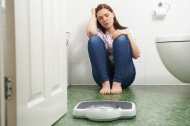
 I like to share the most recent news regarding anything to do with weight loss or dieting. Every month I receive the Journal of the Academy of Nutrition and Dietetics (AND) which used to be the American Dietetic Association (ADA). It was hard for me to get used to the new name as I am an older dietitian and for a few decades it has been ADA to me. Anyway, the journal always comes because I pay my fees and it has lots of articles, mostly research (not always interesting to me, I have to admit). But I just love when they publish a new Position Paper because many dietitians have reviewed years of research (not the most fun thing to do) and then let us know how we should do our job. As a Registered Dietitian, I don’t have time to do that ( FYI a Registered Dietitian is an RD or RDN, Registered Dietitian Nutritionist, a newer designation I think recently added because people like the word “nutritionist” better than dietitian, and anyone, yes anyone, can call themselves a nutritionist, but only those of us who have gone through 4 years of college as well as a clinical training or internship and then passing a national exam can then call ourselves a “dietitian”). So when you are seeking advice about nutrition you really need to talk to an RD or RDN.



 Joanne Arena MS, RD